On this page
Hair loss is not a single condition
Thinning, finer hair shafts and increased daily shedding are not necessarily the same problem. Male- and female-pattern loss often progresses gradually in a characteristic distribution. Stress, fever, rapid weight loss, medicines, iron deficiency or thyroid problems may contribute to more sudden, diffuse shedding.
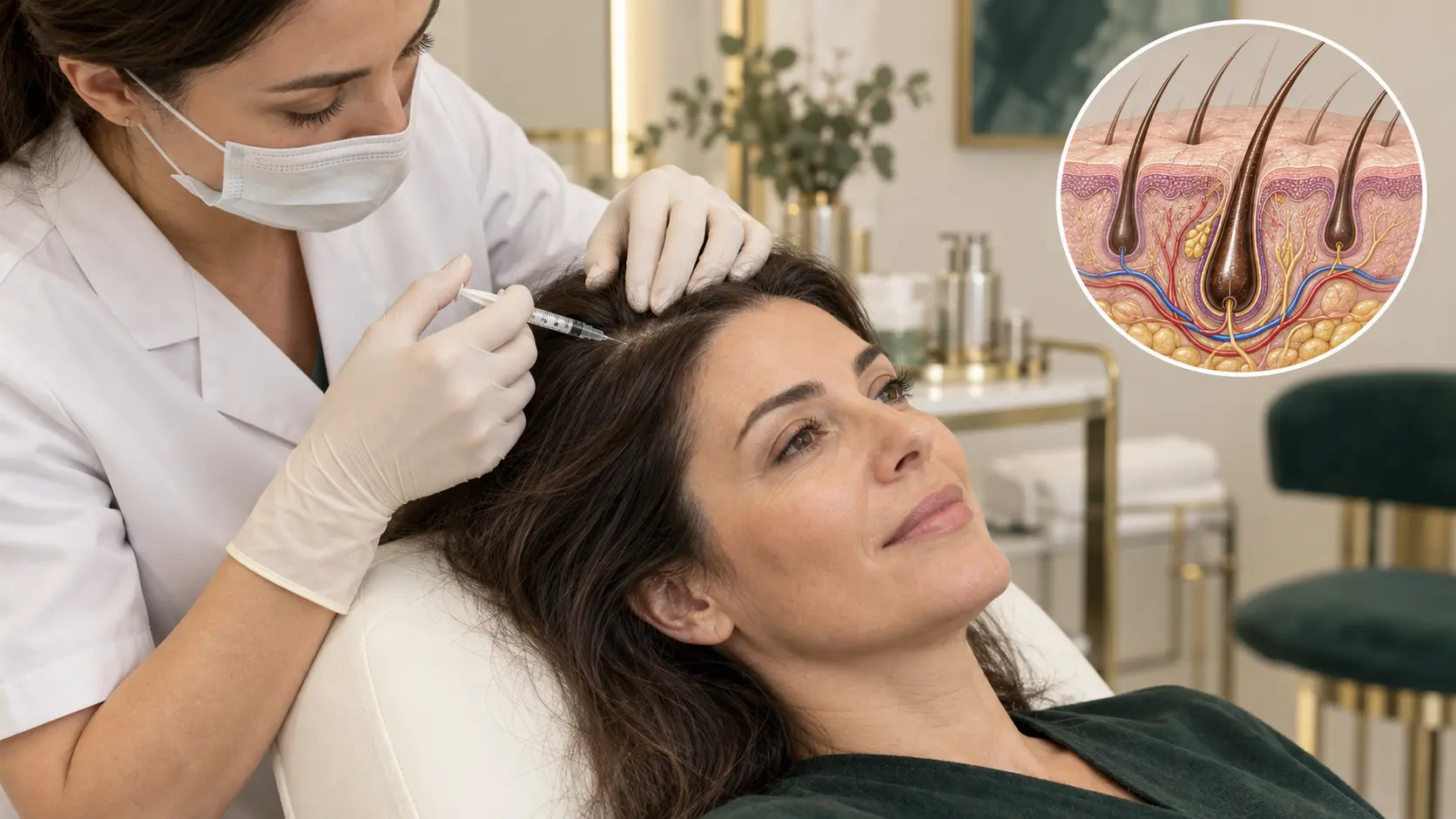
I first ask when the change started and how it has progressed, then examine the scalp for other findings. We discuss injection options after that assessment.
What I assess at the first consultation
- Pattern: duration, sudden or gradual onset, localised or diffuse loss and family history.
- Scalp and health: itching, redness, scaling, tenderness, illness, medicines, nutrition and hormonal changes.
- Investigations: blood counts, iron stores, thyroid tests or dermatology assessment may be appropriate according to the history.
When may injections be considered?
PRP, mesotherapy and exosome approaches are most often discussed as support within a plan for male- or female-pattern thinning. Expectations may be more realistic in early or moderate stages where active follicles remain but shafts are becoming finer.
They cannot be said to recreate follicles that have long disappeared. Sudden patches, inflammation, pain, crusting or scarring need diagnostic assessment first.
Scalp mesotherapy
Scalp mesotherapy uses different formulations, which may contain amino acids, peptides, vitamins, non-cross-linked hyaluronic acid or other ingredients. It does not refer to one product, and a longer ingredient list does not establish greater effectiveness.
Suitability for scalp injection, dose, allergies and interactions need consideration. Research uses different formulations and schedules, so there is no universal result or protocol for all products.
PRP for hair
PRP is a platelet- and growth-factor-rich preparation made from your own blood and injected into the scalp. The intention is to support the tissue response around follicles through platelet-derived biological factors.
At my practice I use a CGF preparation approach and controlled ozone–oxygen exposure before application. Areas and session plans depend on the pattern of loss and scalp condition. Read more about PRP preparation.
Scalp exosome applications
Exosomes are small extracellular vesicles involved in cell communication. At my practice, products whose suitability has been verified are administered by direct injection to planned areas.
Cell source, manufacturing, purification, particle concentration, added ingredients, sterility and storage vary. Small human studies have reported positive density findings, but long-term data and standardised schedules remain insufficient. Read more about product differences.
When should the response be assessed?
The hair cycle is slow. Fullness in the days after injection does not mean that new hair has formed. Shedding changes may be noticed sooner, but a first meaningful photographic and density comparison is often made at three months.
Shaft thickness and density are more meaningfully assessed around six months. Consistent photography and, when possible, measurements in the same area are more reliable than daily mirror checks.
Are injections enough on their own?
Genetic and hormonal tendencies continue in androgenetic hair loss. Injections may support suitable medical treatment, but diagnosis and necessary care remain part of the plan. Injections alone are not always enough.
We also assess possible contributors such as iron deficiency, thyroid disease, medication or severe recent stress. Scalp injections do not address those causes on their own. I may recommend not injecting after the assessment.
Treatment and aftercare
After cleansing, small amounts of the selected preparation are injected at planned sites. Duration varies with area and method. Redness, tenderness, small bumps or bruising may occur and often decrease over one to three days.
Initially avoid scalp irritation, intense heat and scratching. Increasing pain, marked swelling, warmth or discharge warrant contact with the practice.
When extra care is needed
Discuss active infection or inflammation, wounds, significant bleeding disorders, serious immune-related illness, pregnancy or breastfeeding, and medication. For PRP, blood counts and medicines affecting platelet function also matter.
Rapidly enlarging patches, marked pain, inflammation, apparent scarring or simultaneous eyebrow and eyelash loss make dermatological diagnosis a priority before supportive injections.
Frequently asked questions
Are injections suitable for every type of hair loss?
No. They may be considered as support for inherited pattern thinning, while sudden, patchy, inflammatory or scarring loss requires a different approach.
When may a response become visible?
New hair within a few weeks is not a realistic expectation. Shedding may change earlier, but photographs and density are usually first assessed at three months and more meaningfully around six months.
How many scalp PRP sessions are used?
One common starting plan is three sessions spaced three to four weeks apart. Stage and response may change the plan. Reviews at three and six months help guide further treatment.
Are mesotherapy and PRP the same?
No. PRP comes from your own blood; mesotherapy uses preformulated injectable products. Ingredients and intended use need separate assessment.
How are scalp exosome products applied?
I use direct injection of products whose suitability has been verified. Source, manufacturing, sterility and preparation for injection matter. Human studies are promising, but products and protocols are not yet standardised.
Can PRP, mesotherapy and exosomes be combined?
These methods can be used at different stages of a plan. The cause of loss, scalp condition, previous treatments and the purpose of each method guide selection and timing. All three need not be used together.
Will shedding stop after one session?
No such guarantee can be given. Androgenetic loss is progressive, and injections do not remove the underlying tendency. The aim is to support existing hair and the overall plan, with medical treatment when appropriate.
Sources and further reading
- S1 guideline for diagnostic evaluation in androgenetic alopecia in men, women and adolescents
- Microneedling radiofrequency: a review of clinical findings
- Systematic review of mesotherapy: a novel avenue for the treatment of hair loss
- Exosomes and Hair Regeneration: A Systematic Review of Clinical Evidence Across Alopecia Types and Exosome Sources
- Effectiveness of Exosome Treatment in Androgenetic Alopecia: Outcomes of a Prospective Study